Thunder Compute's GPU sandboxes cost less than Modal's and are never preempted, while Modal offers more GPU types, persistent storage and a broader serverless platform.
Takeaways
- Thunder Compute sandboxes are on-demand; Modal GPU Sandboxes are preemptible.
- Thunder Compute costs 27% less for an 8 vCPU, 32 GiB H100 sandbox ($3.88/hr vs $5.29/hr).
- Modal offers eleven GPU types; Thunder Compute offers the H100 and A100 80GB.
- Modal supports persistence through volumes and filesystem snapshots; Thunder Compute sandboxes are ephemeral.
- Modal adds region multipliers and egress fees; Thunder Compute has neither.
Modal and Thunder Compute both give AI agents an isolated environment with a real GPU, but they isolate and bill it differently.
Modal vs Thunder Compute at a Glance
Thunder Compute leads on price and guaranteed runs, and Modal leads on GPU range and persistence. Both platforms bill per second and charge for CPU and memory on top of the GPU.
| Feature | Modal | Thunder Compute |
|---|---|---|
| GPU types | T4 to B300 (11 types) | H100, A100 80GB |
| H100 price | $3.95/hr | $2.95/hr |
| H100 sandbox, 8 vCPU and 32 GiB | $5.29/hr | $3.88/hr |
| Preemption | Preemptible only | Non-preemptible |
| Isolation | gVisor | Firecracker microVM |
| Max GPUs per sandbox | Not documented | 1 |
| Session length | 5-minute default, up to 24 hours | 300-second SDK default, configurable or no expiry |
| Persistence | Volumes and filesystem snapshots | Ephemeral |
| Egress | $0.04/GiB beyond the plan allowance | Not billed |
| Free credits | $30/month on the Starter plan | None |
What Modal Sandboxes Are and How They Work
Modal Sandboxes are isolated containers for running untrusted code inside Modal's platform. Teams can run Modal Sandboxes next to Modal functions, inference endpoints and batch jobs. The Python SDK is Modal's primary interface, with JavaScript and Go SDKs in beta.
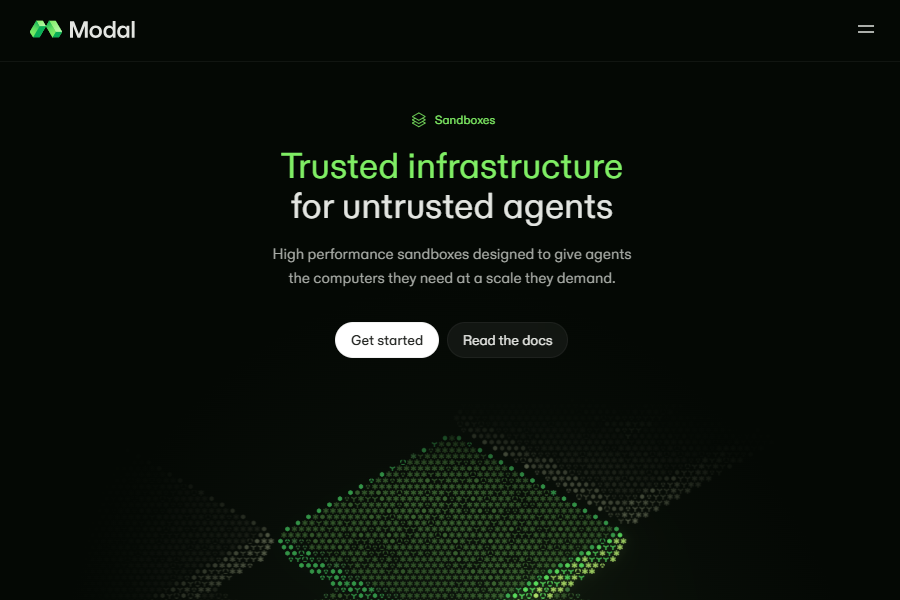
Modal Sandboxes default to a 5-minute lifetime and can run for up to 24 hours. Workflows that need longer runs save state and restore it into a new Modal Sandbox.
What Thunder Compute Sandboxes Are and How They Work
Thunder Compute sandboxes are short-lived GPU environments, each running in its own Firecracker microVM (AWS's open-source microVM hypervisor). Teams create them through a Python SDK or REST API. Every sandbox declares its vCPUs, memory, disk and GPU at creation, along with a lifetime and a network policy.
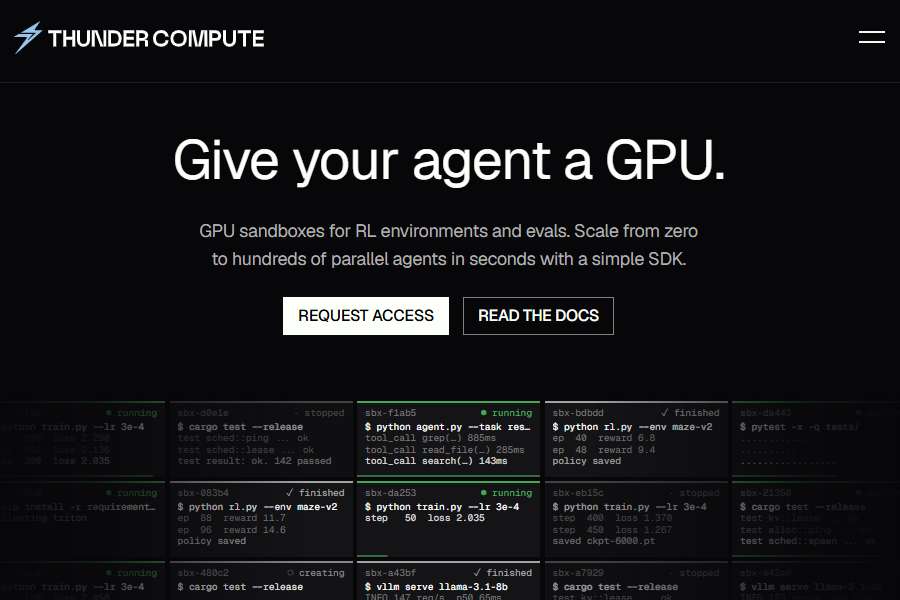
Commands in a Thunder Compute sandbox run as durable jobs that survive client disconnects. Each sandbox is ephemeral, so results need to be downloaded before it terminates. Sandbox access is enabled per organization.
Preemption: Interruptible vs Guaranteed GPU Runs
Modal GPU Sandboxes can be preempted, while Thunder Compute sandboxes can't. Modal's sandbox docs state that GPU Sandboxes are subject to preemption, unlike Modal's CPU Sandboxes. Modal recommends designing GPU workloads to handle interruptions.
Preemption matters most for long evals and reinforcement learning (RL) rollouts. An evicted run has to start over, so its cost includes the work already done. A Thunder Compute run finishes at the quoted price, because Thunder Compute sandboxes are non-preemptible.
Isolation: gVisor vs Firecracker MicroVMs
Thunder Compute gives each sandbox its own guest kernel, while Modal filters system calls in user space. Modal GPU Sandboxes run on gVisor (Google's sandboxed container runtime), which intercepts system calls and proxies GPU driver calls to the host. Thunder Compute runs each sandbox in a Firecracker microVM.
Firecracker doesn't support GPU passthrough, but Thunder Compute uses custom software to bypass this limitation. Agent code on Thunder Compute gets microVM-level isolation and speed with a GPU in the same environment.
Read our guide to GPU sandboxes and how GPU isolation works.
Modal Sandboxes Pricing vs Thunder Compute Pricing
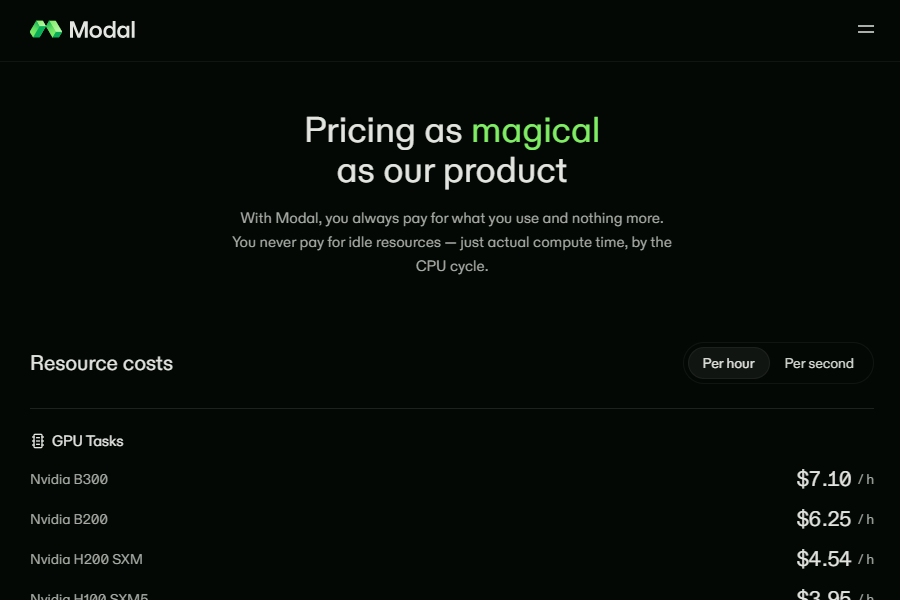
Thunder Compute's H100 costs $2.95/hr, a dollar less than Modal's $3.95/hr. The gap widens once CPU and memory are added. An H100 sandbox with 8 vCPUs, 32 GiB of memory and 100 GiB of disk costs about $5.29/hr on Modal and $3.88/hr on Thunder Compute.
Modal's Sandbox CPU and Memory Premium
Modal charges about $0.071/vCPU-hr and $0.024/GiB-hr in Sandboxes, compared with $0.051 and $0.016 on Thunder Compute. Modal also bills whichever is higher, the resource request or actual usage. A Modal Sandbox that bursts above its request costs more unless you set CPU and memory limits.
Modal adds two charges that Thunder Compute doesn't. Pinning a sandbox to a region multiplies prices by 1.15x or 1.75x, and egress costs $0.04/GiB beyond the plan's monthly allowance. Thunder Compute has no multipliers and doesn't charge for egress.
See the full GPU sandbox price breakdown across Modal, Daytona and Thunder Compute.
GPU Options, Session Limits and Persistence
Modal offers far more hardware choice than Thunder Compute. Modal's GPU lineup runs from the T4 to the B300, eleven types in total, while Thunder Compute offers the H100 and the A100 80GB. Thunder Compute supports one GPU per sandbox, and Modal doesn't document a GPU limit for Sandboxes.
Thunder Compute suits long jobs, and Modal suits jobs that need saved state. Modal caps a sandbox at 24 hours, while Thunder Compute's timeout is configurable and can be disabled. Modal supports volumes and filesystem snapshots, while Thunder Compute sandboxes are ephemeral.
Developer Experience: SDKs, Networking and Access
Modal has the larger SDK surface, and Thunder Compute has the simpler resource model. Modal offers Python, JavaScript and Go SDKs and fits teams already deploying functions on Modal. Thunder Compute offers a Python SDK with sync and async clients plus a REST API, and every sandbox declares its exact resources up front.
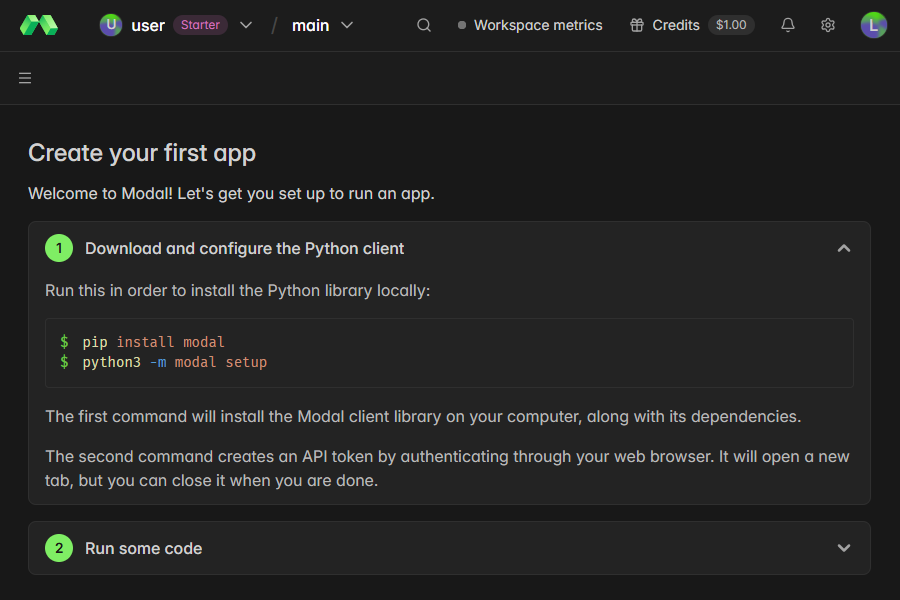
Modal and Thunder Compute both let you lock down sandbox networking. Thunder Compute supports closed, open and allowlisted network policies, with CIDR and domain allowlists, plus SSH access. Modal can block network access or restrict outbound traffic. Modal also includes $30 of monthly credit on its Starter plan.
Last Thoughts on Modal vs Thunder Compute
Modal suits teams that need many GPU types, persistent storage and a full platform, and that can tolerate preemption. Thunder Compute suits teams that need guaranteed single-GPU runs at a lower price, with microVM isolation. Start by considering whether your jobs can survive interruptions, since that answer usually settles the choice.
FAQ
Is Thunder Compute Cheaper Than Modal for GPU Sandboxes?
Yes. Thunder Compute's H100 costs $2.95/hr against Modal's $3.95/hr, and a full 8 vCPU, 32 GiB H100 sandbox costs about $3.88/hr against $5.29/hr. Thunder Compute also has no region multipliers or egress fees.
How Do Modal and Thunder Compute Isolate Sandboxes?
Modal runs GPU Sandboxes on gVisor, a user-space kernel that intercepts system calls. Thunder Compute runs each sandbox in a Firecracker microVM with its own guest kernel.
Which GPUs Do Modal and Thunder Compute Sandboxes Support?
Modal supports eleven GPU types, from the T4 to the B300. Thunder Compute supports the H100 and the A100 80GB, with one GPU per sandbox.
How Long Can a Modal or Thunder Compute Sandbox Run?
Modal Sandboxes default to 5 minutes and can run for up to 24 hours. Thunder Compute sandboxes default to 300 seconds in the SDK, and the timeout can be raised or disabled.
Do Modal and Thunder Compute Sandboxes Keep Data?
Modal supports volumes and filesystem snapshots. Thunder Compute sandboxes are ephemeral, so you need to download results before a sandbox terminates.