Daytona is the better fit for GPU jobs that can't be interrupted, while Modal offers more GPU types and persistent storage. Modal GPU Sandboxes are preemptible only. Daytona offers on-demand GPU sandboxes that aren't preempted along with a cheaper spot tier.
Takeaways
- Preemption is the deciding difference: Modal GPU Sandboxes are preemptible only, while Daytona offers both spot and on-demand capacity.
- Modal offers more GPU types, eleven from the T4 to the B300, against Daytona's seven.
- Modal's higher CPU and memory rates raise prices to $5.29/hr vs $4.88/hr (8 vCPUs, 32 GiB memory, 100 GiB disk).
- Daytona's 15-minute auto-stop can delete a running GPU job unless you change the default.
Modal vs Daytona at a Glance
Modal leads on GPU range and persistence, and Daytona wins on on-demand capacity. Both platforms bill per second and charge for CPU and memory on top of the GPU.
| Feature | Modal | Daytona |
|---|---|---|
| GPU types | T4, L4, A10, L40S, A100 40GB and 80GB, RTX PRO 6000, H100, H200, B200, B300 | RTX 4090, RTX 5090, RTX PRO 6000, H100, H200, AMD MI355X, B200, B300 |
| GPU isolation | gVisor | Dedicated GPUs in sandbox VM |
| Preemption | Preemptible only | On-demand or spot |
| H100 price | $3.95/hr | $3.95/hr on-demand, $2.27/hr spot |
| Session length | 5-minute default, up to 24 hours | Auto-stops after 15 idle minutes by default, no maximum |
| Persistence | Volumes and filesystem snapshots | Filesystem snapshots |
| Bring your own compute | No | Yes |
What Are Modal Sandboxes?
Modal Sandboxes run untrusted agent code in isolated containers, and can request GPUs. Modal GPU Sandboxes offer GPUs from a T4 to a B300, run only on Modal's gVisor runtime and, unlike CPU Sandboxes, can be preempted. Modal's Python SDK is the primary interface, with JavaScript and Go SDKs in beta.
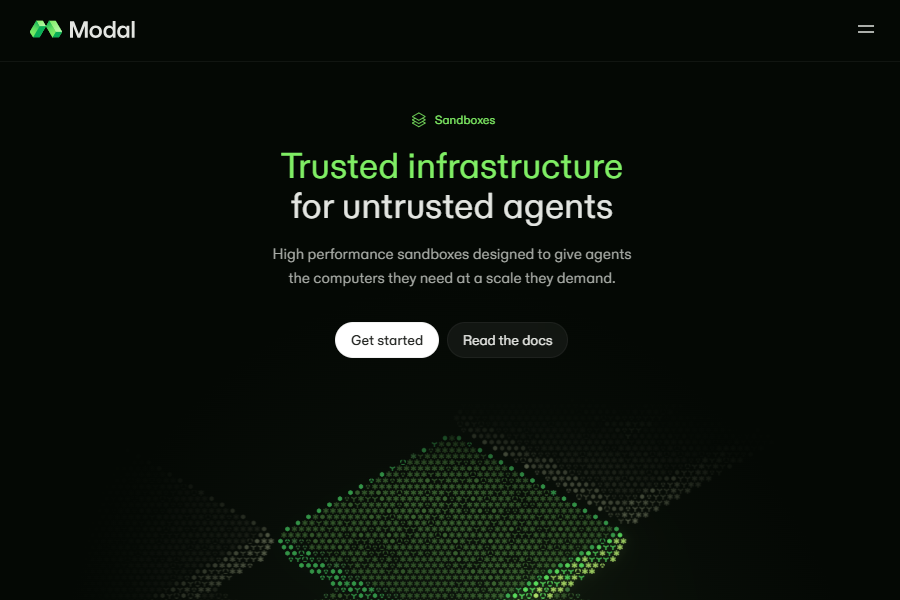
Modal Sandboxes default to a 5-minute lifetime and can run for up to 24 hours. Long GPU workflows save state to Modal Volumes and restore it into a new sandbox.
What Is a Daytona Sandbox?
Daytona sandboxes run as containers by default, while Daytona GPU sandboxes are a separate class. Daytona GPU sandboxes offer GPUs from an RTX 4090 to a B300, each passed into a sandbox VM. Teams manage both classes through SDKs for Python, TypeScript, Ruby, Go and Java.
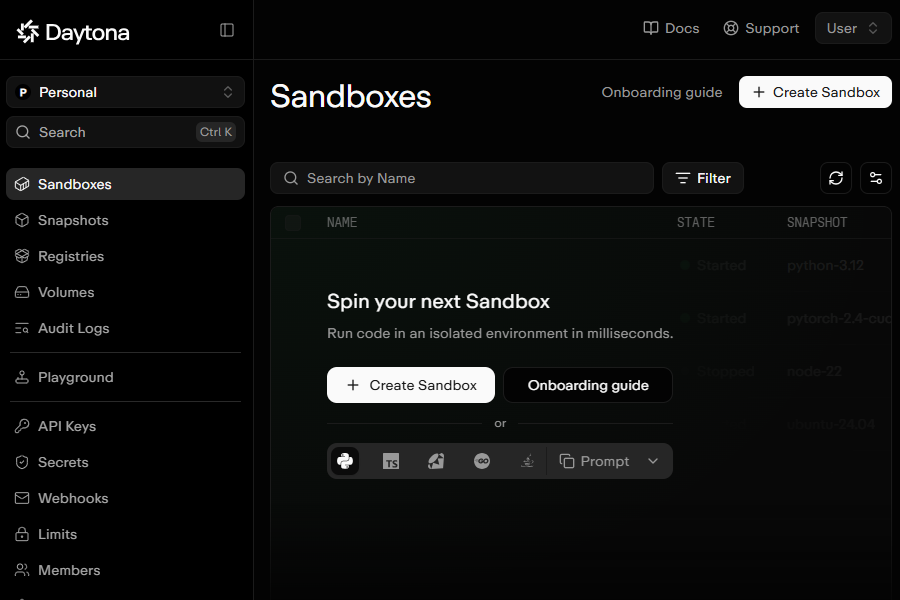
Daytona GPU sandboxes are ephemeral and deleted when they stop, unlike Daytona's longer-lived CPU sandboxes. GPU sandboxes come in on-demand and spot tiers and support filesystem snapshots, with no pause or fork.
GPU Support: Types, Limits and Isolation
How Each Platform Isolates a GPU
Modal GPU Sandboxes run only on the gVisor runtime. gVisor (Google's sandboxed container runtime) is a user-space kernel that intercepts system calls. Daytona assigns GPUs into a sandbox VM.
Preemption and GPU Capacity
Preemption is the biggest practical difference between Modal and Daytona. Modal GPU Sandboxes are subject to preemption, and Modal offers no non-preemptible option for them. Long jobs on Modal need to tolerate interruption.
Daytona GPU sandboxes are on-demand by default, and on-demand requests wait for capacity when no GPU is free. Daytona's spot tier costs about 42% less, but spot GPU sandboxes can be terminated without notice. Spot requests also fail immediately when no capacity is available.
Modal Sandboxes Pricing vs Daytona Sandbox Pricing
Modal and Daytona charge the same on-demand rate for every GPU they both offer, including $3.95/hr for an H100. Daytona costs less once CPU and memory are added. An H100 sandbox with 8 vCPUs, 32 GiB of memory and 100 GiB of disk costs about $5.29/hr on Modal and $4.88/hr on Daytona on-demand. The same sandbox costs $3.20/hr on Daytona spot.
Modal charges more for Sandbox CPU and memory than for its regular functions: about $0.071/vCPU-hr and $0.024/GiB-hr. Pinning Modal Sandboxes to a region adds a 1.15x or 1.75x multiplier. Modal charges $0.04/GiB for egress once a workspace uses its monthly allowance. Daytona bills only reserved vCPU, RAM and disk, plus GPUs, with no egress line item.
Read nextGPU Sandbox Pricing H100 GPU rates, CPU and memory charges, preemption policies and cost scenarios.
Lifecycle, Persistence and Session Limits
Modal caps sessions at 24 hours and offers persistence through volumes and filesystem snapshots. Daytona has no maximum session length. Daytona GPU sandboxes are ephemeral, though, and support filesystem snapshots only, with no pause, fork or memory snapshots.
Auto-Stop and the Risk of Losing a GPU Job
Daytona's default auto-stop can end a GPU job that's still running. Daytona's auto-stop triggers after 15 minutes of inactivity even if processes are running, because background tasks don't reset the inactivity timer. Daytona GPU sandboxes are deleted when they stop, so a long inference or eval job can lose its work under default settings.
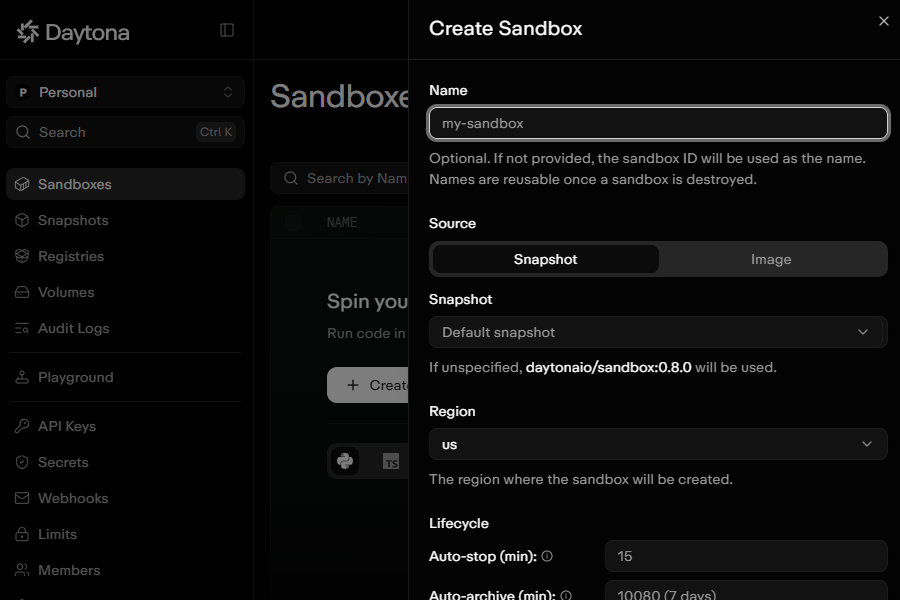
Set Daytona's auto-stop interval to 0, or refresh the sandbox's activity from your harness, for any GPU job longer than 15 minutes. A wall-clock TTL can then cap the sandbox's total lifetime.
Networking and Access Controls
Modal and Daytona both restrict what sandbox code can reach, but Daytona ties network access to account tier. Modal Sandboxes can block network access or limit outbound traffic to allowlisted destinations. Tier 1 and 2 organizations get restricted internet access on Daytona that sandbox settings can't override. Daytona Tier 3 and 4 organizations get full access with custom rules.
Daytona supports bring your own compute through custom regions, for teams that must keep workloads on their own machines. Modal runs as a managed service only.
A Third Option: Non-Preemptible H100s on Thunder Compute
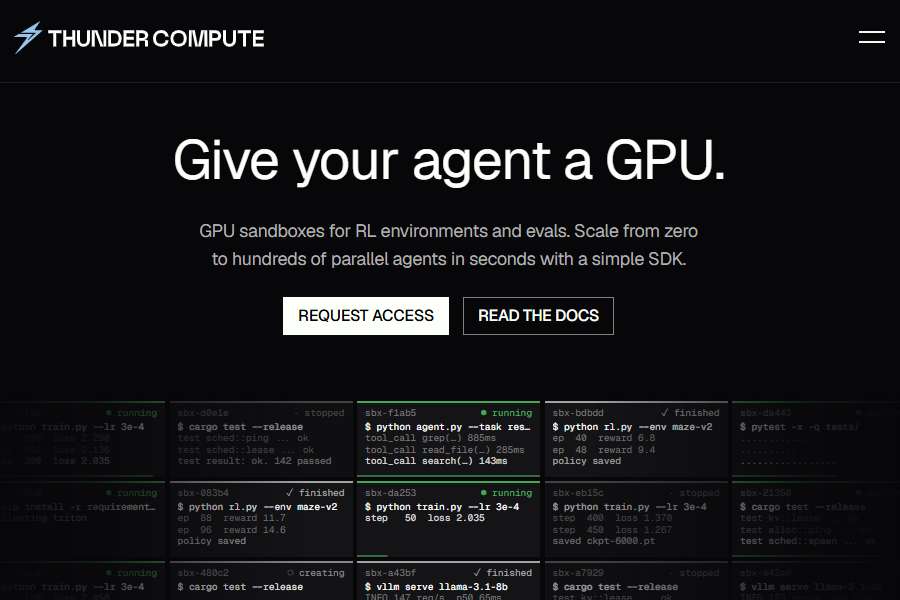
Thunder Compute offers guaranteed GPU runs at a lower rate than Modal or Daytona. Thunder Compute's H100 sandboxes cost $2.95/hr, are never preempted and run in Firecracker microVMs (AWS's open-source microVM hypervisor).
Last Thoughts on Modal vs Daytona
Modal and Daytona both offer GPU sandboxes, and the right pick depends on how a workload handles interruptions. Modal wins on GPU range, persistence and platform breadth, while Daytona wins on on-demand capacity, and price. Check preemption first, then GPU type, then the full hourly cost of your configuration.
NoteModal vs Thunder Compute Compare Modal and Thunder Compute GPU sandbox pricing, isolation and limits. Daytona vs Thunder Compute GPU sandbox pricing, isolation and limits.
FAQ
Which Is Better for GPU Workloads, Modal or Daytona?
Daytona is better for jobs that can't be interrupted, since its on-demand sandboxes aren't preempted. Modal is better for GPU types Daytona doesn't offer and for persistent volumes.
How Long Can a Modal or Daytona Sandbox Run?
Modal Sandboxes default to 5 minutes and can run for up to 24 hours. Daytona sandboxes have no maximum length but auto-stop after 15 idle minutes unless you change the interval.
Is Modal or Daytona Cheaper for GPU Sandboxes?
Daytona is cheaper for the same configuration: both charge $3.95/hr for an H100, but Daytona's CPU and memory rates are lower. Daytona's spot tier cuts the cost further for jobs that tolerate interruption.
How Do Modal and Daytona Isolate GPU Sandboxes?
Modal GPU Sandboxes run only on gVisor, a user-space kernel that intercepts system calls. Daytona dedicates each GPU to one sandbox and passes it directly into a sandbox VM.
Does Modal or Daytona Charge for Egress?
Modal charges $0.04/GiB for egress once a workspace uses its monthly allowance. Daytona bills only reserved vCPU, RAM, disk and GPUs, with no egress line item.