The NVIDIA RTX PRO 6000 Blackwell is the most powerful desktop GPU available in September 2026. It targets professionals in 3D rendering, simulation, and local AI development, packing 96GB of GDDR7 VRAM and Blackwell's 5th-generation Tensor Cores into a workstation form factor.
Its price has climbed sharply since launch, making rental the practical choice for most projects.
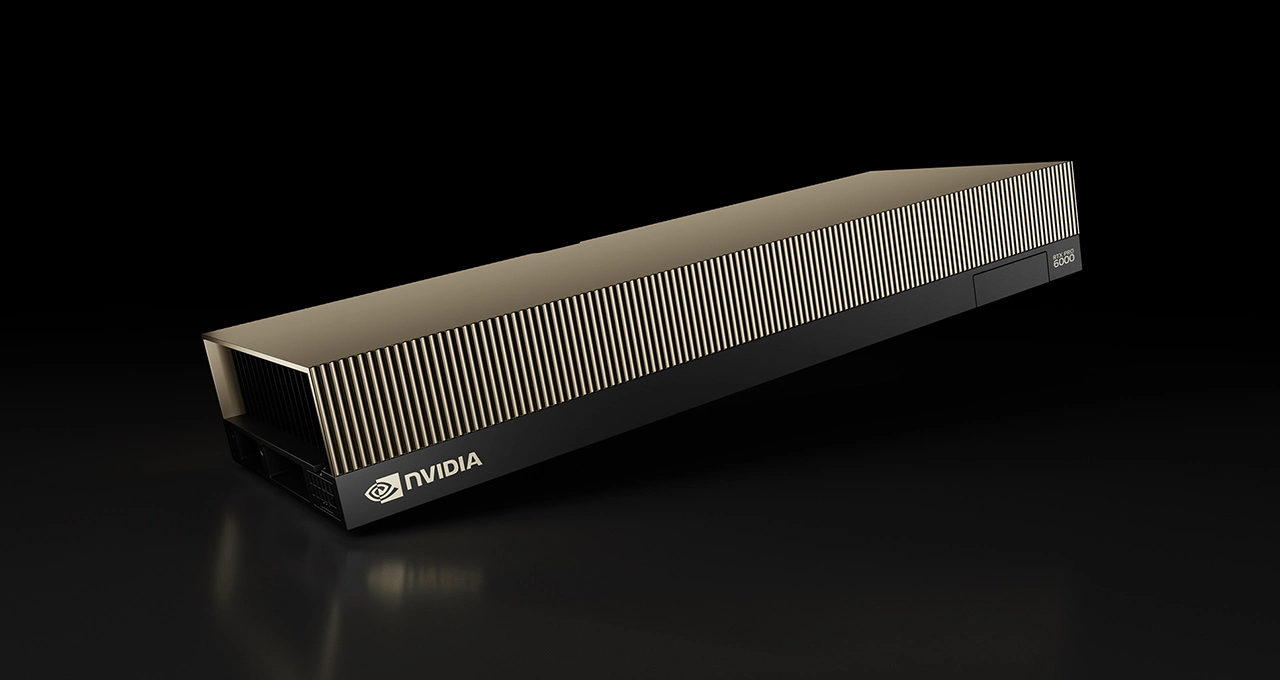
NVIDIA RTX PRO 6000 Blackwell Price
The RTX PRO 6000 Blackwell launched in March 2025 at an MSRP of $8,565. As of September 2026, NVIDIA's official marketplace lists the card at $16,000, an 87% increase in roughly 18 months.
Prices vary slightly across retailers:
- NVIDIA Marketplace: $16,000
- Newegg: $15,999+
- B&H Photo: $15,999+
- Refurbished/Used: $14,980–$18,850 (limited availability)
Why Is the RTX PRO 6000 Price Rising?
The primary driver is the GDDR7 memory shortage. The RTX PRO 6000 Blackwell uses 96GB of GDDR7 in a clamshell design, the largest VRAM of any workstation-class graphics card, which makes it acutely sensitive to GDDR7 supply constraints. The increase reflects supply-and-demand pressure in the GDDR7 memory market.
There is no clear near-term relief. NVIDIA holds a near-monopoly on high-VRAM professional GPUs, and AI-driven demand shows no sign of cooling. Cloud rental rates have stayed comparatively stable, so renting reduces exposure to ongoing hardware price volatility and depreciation.
How Much Does it Cost to Rent?
With the upfront cost exceeding $16,000, renting has become even more compelling. Below are current on-demand rates across cloud providers:
This pricing information is reviewed weekly.
| Provider | GPU / Instance | On-Demand $/GPU-hr* | Notes |
|---|---|---|---|
| Vast.ai | RTX PRO 6000 Blackwell | $1.57 | Median of 28 verified US/CA hosts, priced as compute plus 100 GB storage; bandwidth billed separately. |
| Nebius | RTX PRO 6000 Blackwell | $1.80 | |
| Runpod | RTX PRO 6000 Blackwell | $2.09 | |
| CoreWeave | 8 x RTX PRO 6000 Blackwell | $2.50 | Normalized from an 8-GPU node. |
| Modal | RTX PRO 6000 Blackwell | $3.03 | |
| AWS | g7e.2xlarge | $3.36 | Cheapest US region (us-east-1); ranges $3.36-$5.27/GPU-hr across 18 US options. |
| Google Cloud | g4-standard-48 | $4.50 | Cheapest US region (us-central1); ranges $4.50-$4.95/GPU-hr across 9 US options. |
| Oracle Cloud | OCI - Compute - GPU - RTX PRO 6000 | $4.50 | |
| Azure | Standard_NC288ds_xl_RTXPRO6000BSE_v6 | $5.50 | Cheapest US region (eastus); ranges $5.50-$7.15/GPU-hr across 5 US options. |
| Last reviewed on September 11, 2026. | |||
Note: Thunder Compute doesn't offer the RTX PRO 6000, but at $3.20/hr it offers the NVIDIA H100, a superior GPU for AI and machine learning.
AWS G7e Instances
AWS offers NVIDIA RTX PRO 6000 Blackwell Server Edition GPUs through its EC2 G7e family, launched in January 2026.
G7e instance characteristics:
- NVIDIA RTX PRO 6000 Blackwell Server Edition GPUs (96GB GDDR7 VRAM per GPU)
- 8–192 vCPUs
- 64–2,048GB RAM
- Up to 15.2 TB local NVMe SSD storage
AWS bills per-second (60-second minimum). Egress fees apply at $0.09/GB after the first free 100GB per month.
| SKU | RTX PRO 6000 GPUs | vCPUs | RAM (GB) | Hourly price | Price per GPU |
|---|---|---|---|---|---|
| g7e.2xlarge | 1 | 8 | 64 | $3.36 | |
| g7e.4xlarge | 1 | 16 | 128 | $4.00 | |
| g7e.8xlarge | 1 | 32 | 256 | $5.27 | |
| g7e.12xlarge | 2 | 48 | 512 | $8.29 | $4.14 |
| g7e.24xlarge | 4 | 96 | 1,024 | $16.57 | $4.14 |
| g7e.48xlarge | 8 | 192 | 2,048 | $33.14 | $4.14 |
Read the complete guide on EC2 GPU instances for a full breakdown of all G-series and P-series pricing, spot discounts, and cost optimization strategies.
Google Cloud G4 Instances
GCP's accelerator-optimized G4 machine family features:
- NVIDIA RTX PRO 6000 Blackwell Server Edition GPUs
- 5th Gen AMD EPYC (Turin)
- 4:1 RAM-to-vCPU ratio on all
g4-standard-shapes - One RTX PRO 6000 GPU per 48 vCPUs, scaling to 8 GPUs
| Provider | SKU | RTX 6000 GPUs | VCPUs | RAM | Hourly price | Price per-GPU |
|---|---|---|---|---|---|---|
| GCP | g4-standard-6 | 0.125 | 6 | 22 | $0.56 | $4.50 |
| GCP | g4-standard-12 | 0.25 | 12 | 45 | $1.12 | $4.50 |
| GCP | g4-standard-24 | 0.5 | 24 | 90 | $2.25 | $4.50 |
| GCP | g4-standard-48 | 1 | 48 | 180 | $4.50 | |
| GCP | g4-standard-96 | 2 | 96 | 360 | $9.00 | $4.50 |
| GCP | g4-standard-192 | 4 | 192 | 720 | $18.00 | $4.50 |
| GCP | g4-standard-384 | 8 | 384 | 1440 | $36.00 | $4.50 |
Azure NC RTX PRO 6000 BSE v6 Instances
Microsoft Azure offers the RTX PRO 6000 Blackwell Server Edition through its NC RTX PRO 6000 BSE v6 series (NCv6), powered by Intel Xeon Granite Rapids CPUs (up to 4.2 GHz all-core turbo).
NC RTX PRO 6000 BSE v6 instance characteristics:
- NVIDIA RTX PRO 6000 Blackwell Server Edition GPUs (96GB GDDR7 per GPU)
- Fractional GPU sizes (down to 1/4 GPU) via SR-IOV
- Up to 288 vCPUs (Intel Xeon Granite Rapids)
- Up to 1,032GB DDR5 RAM
- Not currently supported on AKS or Azure Batch
Azure's on-demand pricing for the NCv6 series is significantly higher than specialized GPU clouds. Azure's cheapest single H100 (the NCads H100 v5) starts at $6.98/hr, versus $3.20/hr on Thunder Compute with no egress fees or quota requirements. Azure also adds egress charges, Azure ML surcharges (~25% for managed tooling), and storage costs on top of the compute rate.
| SKU | GPUs | vCPUs | RAM (GB) | On-Demand ($/hr)* |
|---|---|---|---|---|
| Standard_NC36ds_xl_RTXPRO6000BSE_v6 | 1 | 36 | 132 | $1.44 |
| Standard_NC72ds_xl_RTXPRO6000BSE_v6 | 1 | 72 | 264 | $2.83 |
| Standard_NC144ds_xl_RTXPRO6000BSE_v6 | 1 | 144 | 516 | $6.38 |
| Standard_NC288ds_xl_RTXPRO6000BSE_v6 | 2 | 288 | 1,032 | $11.00 |
| * On-demand (pay-as-you-go) rate for Linux in East US; pricing varies by region and OS. Verify current rates on the Azure pricing page. Every Azure subscription starts with zero GPU quota, so you must request an increase before launching any NCv6 instance. | ||||
Read the complete guide on Azure GPU instances for a full breakdown of pricing, reserved and spot pricing, and a direct cost comparison against AWS and GCP.
RTX PRO 6000 Workstation Edition vs Max-Q vs Server Edition
NVIDIA offers three variants of the RTX PRO 6000 Blackwell. All three share the same Blackwell architecture, 96GB GDDR7 ECC memory, and core counts. The differences are cooling design, power envelope, and form factor.
The RTX PRO 6000 Blackwell Workstation Edition is engineered for maximum performance in single-GPU workstations. Its dual-flow-through active cooler sustains peak performance under a full 600W load, but generates substantial heat that makes multi-card configurations impractical in a standard office environment.
The RTX PRO 6000 Blackwell Max-Q runs at a reduced 300W TDP using a blower-style cooler that exhausts heat out the rear of the chassis. This makes it well suited for multi-GPU workstation builds where thermal management is a concern. AI performance is effectively identical to the full-power variant.
The RTX PRO 6000 Blackwell Server Edition is designed for passive-cooled, rack-mounted data center deployments. It is optimized for multi-GPU server builds, enterprise inference, fine-tuning, HPC, and virtual workstations. Its memory bandwidth is slightly lower at 1.6 TB/s versus 1.8 TB/s on the workstation variants, though the difference is marginal for most AI workloads.
For AI performance, all three versions are equivalent. The choice depends on form factor and thermal environment.
| Workstation Edition | Max-Q Edition | Server Edition | |
|---|---|---|---|
| Target environment | Single-GPU desktop workstations | Multi-GPU workstations | Data center racks |
| Cooling | Active dual-flow-through | Blower (rear exhaust) | Passive |
| TDP | 600W | 300W | 400–600W |
| Multi-GPU suitability | Limited (high heat output) | Good | Best |
| Memory bandwidth | 1.8 TB/s | 1.8 TB/s | 1.6 TB/s |
| Memory | 96GB GDDR7 ECC | ||
| Architecture | Blackwell | ||
Hardware Specifications and AI Capabilities
The RTX Pro 6000 is a generational leap over its predecessors, not just a spec bump.
NVIDIA RTX PRO 6000 Blackwell VRAM
At 96GB of GDDR7, VRAM is the standout feature of this card. It means massive models like Llama-3 70B fit on a single card with headroom for high context windows. Memory bandwidth reaches 1,792 GB/s, nearly double the 960 GB/s of the RTX 6000 Ada.
NVIDIA RTX PRO 6000 Blackwell CUDA Cores
The NVIDIA RTX PRO 6000 features 24,064 CUDA cores, delivering 125 TFLOPS of single-precision (FP32) compute.
NVIDIA RTX PRO 6000 Blackwell Tensor Cores
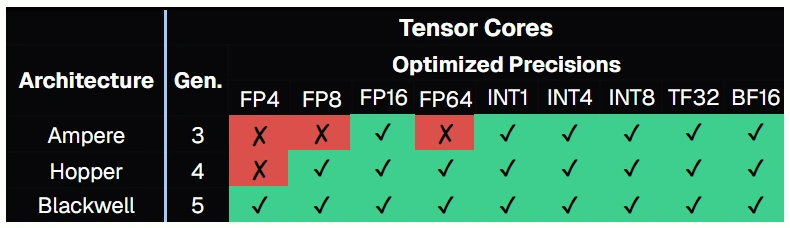
The NVIDIA RTX PRO 6000 has 752 tensor cores providing 126 TFLOPS at full precision. Its 5th-generation tensor cores add native FP4 precision support, a Blackwell-exclusive capability that previous generations lack entirely.
FP4 inference can roughly double throughput compared to FP8 by packing neural network weights at 4x the density of FP16. Modern inference frameworks like vLLM increasingly use FP4 and FP8 modes to maximize tokens-per-second with minimal quality loss for most models. Because the H100 PCIe lacks native FP4 support, for teams prioritizing throughput over maximum precision, this can make the RTX PRO 6000 faster on FP4-quantized single-node inference.
RTX Pro 6000 Blackwell NVLink Support
The RTX Pro 6000 doesn't support NVLink. Previous Quadro generations allowed memory pooling via physical bridges, but NVIDIA has removed this feature from the series entirely.
All multi-GPU communication must happen over the PCIe Gen 5 x16 bus. This cannot match the low-latency GPU-to-GPU bandwidth found in data-center hardware. Workloads requiring massive model parallelism across 4 or 8 GPUs will hit a significant bottleneck.
NVIDIA RTX PRO 6000 Blackwell Power Consumption
The NVIDIA RTX PRO 6000 Blackwell power consumption is rated at 600W for the standard Workstation Edition. This demands a high-end power supply and serious thermal management, making it difficult to stack multiple cards in a standard office environment.
RTX PRO 6000 vs RTX 6000 Ada vs RTX A6000
These GPUs belong to different generations:
| GPU | Architecture | CUDA Cores | Tensor Cores | VRAM | Memory Type | Memory Bandwidth | TDP |
|---|---|---|---|---|---|---|---|
| RTX PRO 6000 | Blackwell | 24,064 | 752 (5th Gen) | 96GB | GDDR7 ECC | 1.8 TB/s | 600W |
| RTX 6000 Ada | Ada Lovelace | 18,176 | 568 (4th Gen) | 48GB | GDDR6 ECC | 960 GB/s | 300W |
| RTX A6000 | Ampere | 10,752 | 336 (3rd Gen) | 48GB | GDDR6 ECC | 768 GB/s | 300W |
For pricing of older cards, see:
The Best Alternative for AI: NVIDIA H100
The RTX Pro 6000 Blackwell is the top workstation GPU available, but the NVIDIA H100 outperforms it for serious AI workloads.
Why the H100 Wins for AI
- Tensor Memory Accelerator (TMA): The H100 features a dedicated TMA that optimizes data movement between memory levels. This is critical for Transformer-based models and offers efficiencies the Pro 6000 cannot replicate.
- True NVLink Scaling: The H100 SXM supports the NVLink Switch System, enabling up to 256 GPUs to communicate at 900GB/s, the key advantage for large-scale distributed training.
- Price: An RTX Pro 6000 now lists at ~$16,000, while a new H100 PCIe costs approximately $25,000–$30,000. At rental prices, the H100 is the clear winner: Thunder Compute offers on-demand H100s for $3.20/hour with no hardware depreciation risk.
Comparison Snapshot: RTX Pro 6000 Blackwell vs. H100
| Feature | RTX Pro 6000 Blackwell | NVIDIA H100 (PCIe) |
|---|---|---|
| Architecture | Blackwell | Hopper |
| VRAM | 96GB GDDR7 | 80GB HBM3 |
| TMA* Support | Limited | Native |
| Interconnect | PCIe Gen 5 | 900GB/s NVLink Switch |
| Target Workload | Design & Development | Foundation Model Training |
| *TMA (Tensor Memory Accelerator): a critical feature for hardware-managed data movement in Hopper and Blackwell architectures. | ||
NVIDIA RTX PRO 6000 Blackwell Release Date
The NVIDIA RTX PRO 6000 Blackwell release date was March 18, 2025, at NVIDIA's GTC conference. It has since become the benchmark for high-end workstation workloads.
Last Thoughts on the NVIDIA RTX PRO 6000 Blackwell
The RTX Pro 6000 Blackwell is uncontested for professional visualization, but the $16,000 entry fee, 600W power draw, and ongoing GDDR7 price pressure make it a poor choice for most AI teams. Renting avoids hardware maintenance, depreciation, and price volatility. Thunder Compute provides instant access to NVIDIA H100s at $3.20/hr, with no long-term commitments.
See how RTX Pro 6000 costs fit into broader industry shifts in the AI GPU rental market trends report.
FAQ
What is the NVIDIA RTX PRO 6000 Blackwell MSRP?
NVIDIA's official marketplace lists the RTX PRO 6000 Blackwell at $16,000, an 87% increase over its $8,565 launch price in March 2025. Third-party pricing varies slightly: Newegg and B&H at $15,999+, and used listings range from $14,980–$18,850.
How much VRAM does the RTX Pro 6000 Blackwell have?
The RTX Pro 6000 Blackwell has 96GB of GDDR7 ECC VRAM, double the 48GB on the previous-generation RTX 6000 Ada.
What is the power consumption of the RTX Pro 6000 Blackwell?
600W TDP for the standard Workstation Edition. The Max-Q variant runs at 300W using a blower-style cooler.
What is the AWS RTX PRO 6000 price?
AWS offers the RTX PRO 6000 Blackwell Server Edition through EC2 G7e instances. A single full GPU starts at $3.36/hr (g7e.2xlarge), scaling to $33.14/hr for eight GPUs (g7e.48xlarge). Prices vary by region.
What is the difference between the RTX PRO 6000 Workstation Edition and Server Edition?
The Workstation Edition uses active dual-flow-through cooling for single-GPU desktops at 600W. The Server Edition uses passive cooling for rack-mounted multi-GPU deployments. AI performance is identical on both.
Why has the RTX PRO 6000 Blackwell price gone up so much?
The card uses 96GB of GDDR7 in a clamshell design, making it acutely sensitive to the ongoing GDDR7 memory shortage. NVIDIA raised the price to $16,000 in August 2026, an 87% increase from launch. Supply-demand pressure in the GDDR7 market is the dominant driver.
What is the RTX PRO 6000 Blackwell Max-Q?
A lower-power variant of the Workstation Edition. It runs at 300W TDP using a blower-style cooler, making it better suited for multi-GPU workstations. AI performance is identical to the full-power variant.